
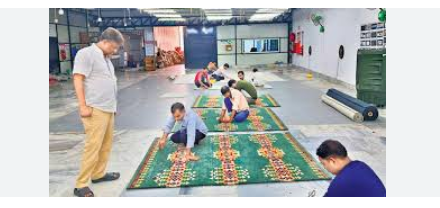
New Delhi: For decades, the Bhadohi district in Uttar Pradesh earned global acclaim as the “Carpet City,” home to skilled artisans producing hand-knotted carpets treasured worldwide.
According to Kashmir Media Service, today, stacks of unsold carpets fill warehouses, once-bustling export offices lie silent, and traders stare anxiously at the immovable piles, waiting for government intervention that may or may not come.
The source of the crisis is clear: the United States’ recent tariff hikes on hand-knotted carpets, which rose from 25 percent to 50 percent, have disrupted an industry that is almost entirely export-oriented.
Imran Ali, a veteran carpet trader from Bhadohi, said: “Our entire livelihood is tied to exports.” “Almost everything we make goes abroad. There is barely any domestic market. These tariffs have brought our business to a grinding halt,” he added.
Read also
- Hindutva group posts Mughal Emperors’ photos in toilets, faces backlashMarch 2, 2025
- India using false allegations to malign Pakistan, suppress minoritiesAugust 19, 2025
He said the hand-knotted carpet industry is unique not just economically, but environmentally. Unlike large textile mills that rely on heavy machinery and emit pollution, Bhadohi’s carpets are entirely handcrafted and carbon-neutral. “We actually contribute to the country’s carbon credits,” he explained, emphasising the sustainable nature of the craft.
Rashid Ahmed, a senior weaver and exporter, explained: “Even if the US were to impose a 500 percent duty, they still cannot produce hand-made carpets themselves. Yet these duties make our goods unaffordable and create hardships for both us and the consumers abroad.”
He said the stakes are enormous. Across eastern Uttar Pradesh, roughly 12–13 lakh people, including Muslim artisans and part-time farmers, depend on the carpet trade. Women form 25 percent of this workforce, many of whom are independent weavers working from home. “They manage households, care for children, and weave carpets according to their own schedules. This employment empowers them economically and socially,” he added.
The tariff increase has led to widespread delays and halted production. “Even orders placed four to six months ago are now on hold,” said Suhail Khan, a Bhadohi exporter. “Buyers refuse to take delivery, saying, ‘Sir, we cannot survive if we pay 25 percent duty; 50 percent is impossible.’ We face a serious threat of irreversible losses if the situation continues,” he lamented.